Questions & Answers

Find the main questions funds ask about AI, Data, sovereignty and the transformation of their operations.

4 results · #Data quality

How Can AI Improve the Quality of Middle Office Controls?
How Can AI Improve the Quality of Middle Office Controls?
By shifting from sample-based verification to comprehensive verification, where humans now handle only the exceptions. AI doesn’t validate anything—it prioritizes, and that’s precisely what the teams are missing.

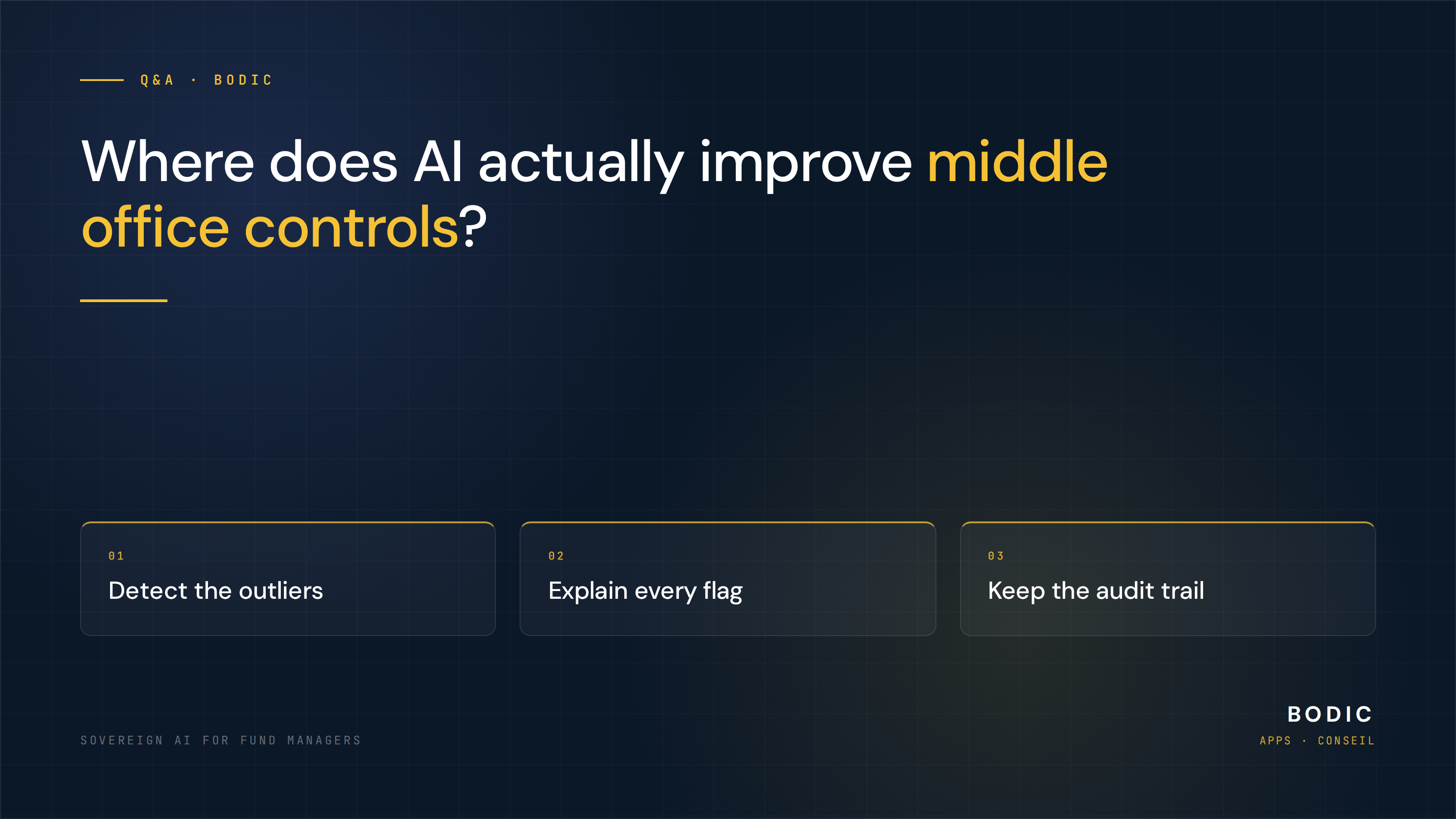
Three concrete benefits. First, detection: anomalous variations from one quarter to the next, inconsistencies between sources, and incomplete fields—across all rows, not just a sample. Next, explanation: each alert must be justified, including the rule that triggered it and the values in question; otherwise, the team will stop reading the alerts. Finally, traceability: who resolved the exception, on what basis, and with what supporting documentation, so that both the regulator and the valuator can follow the trail.

The Bodic Apps Middle Office module applies this logic to data shared with the rest of the platform, eliminating the need for cross-tool consistency checks. The definition of the control plan itself—including thresholds, priorities, and responsibilities—is part of the framework established in collaboration with Bodic Conseil.

Is it possible to effectively automate equity investment reporting?

Is it possible to effectively automate equity investment reporting?
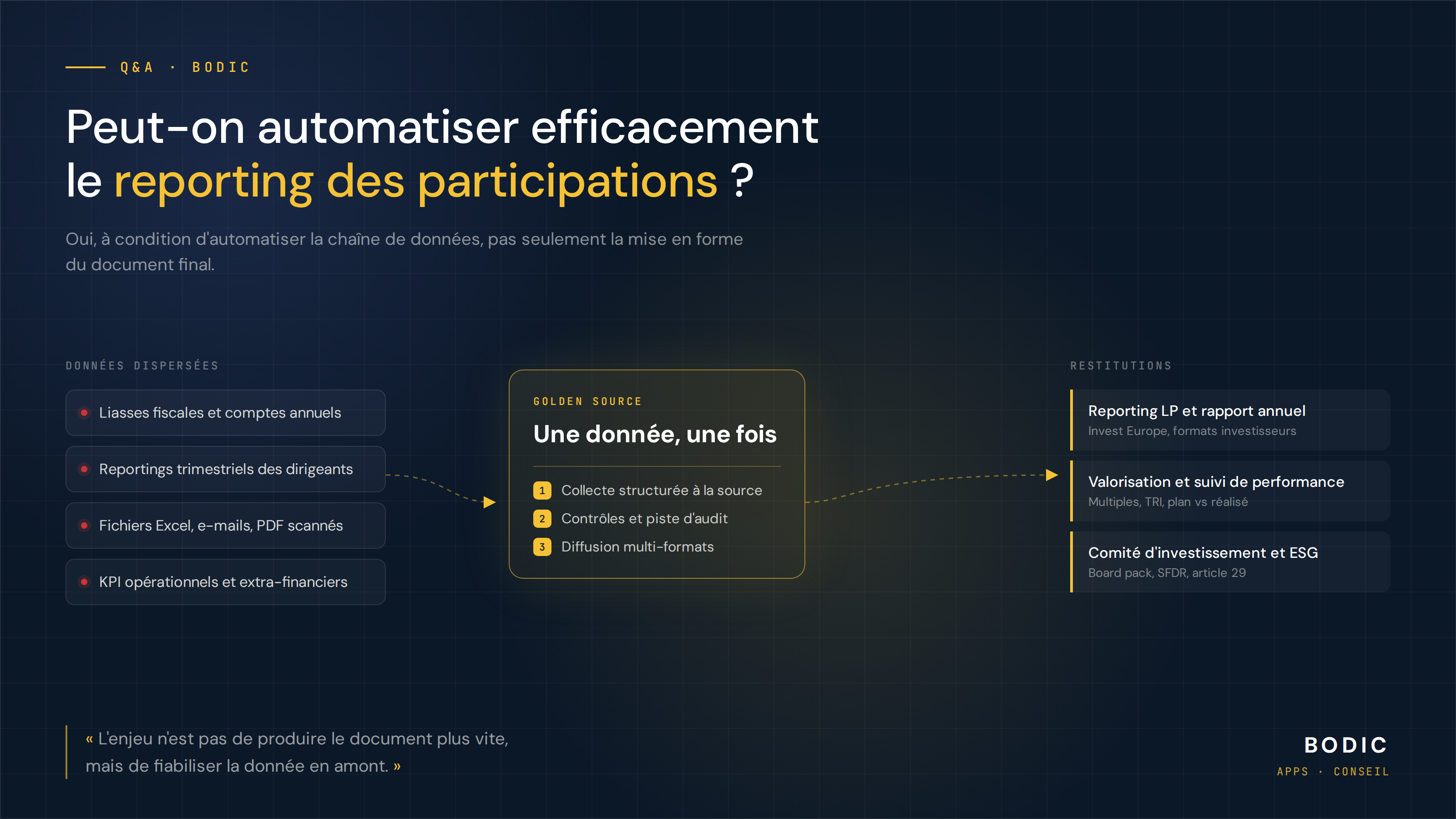
Yes, provided that the data pipeline is automated—not just the formatting of the final document. Most projects fail because they focus on the “last mile”—the LP report or board pack—when the real cost lies upstream: collecting, re-entering, and validating information produced by third parties in different formats and on different schedules.
Three levels of automation, in order of increasing value. First, data collection: a structured data entry portal open to executives at portfolio companies replaces the back-and-forth email cycle and makes the closing date predictable. This is the most significant—and most underestimated—source of savings. Next comes verification: consistency with the previous quarter, variances from the budget, and completeness, with an audit trail that answers the question, “Where does this figure come from?” Finally, reporting—which becomes a simple matter once the data is consolidated, dated, and validated.
There remains one line that must not be crossed. The selection of comparables, the treatment of an exceptional event, and the commentary provided to limited partners are matters of the manager’s judgment. The goal is not to remove the human element, but to reallocate it: less time spent fabricating the numbers, more time spent explaining them.
This is the approach adopted by Bodic Apps, where Portfolio Portal, Middle Office, and Golden Source share the same data rather than duplicating it. The preliminary framework, the set of performance metrics, and change management for portfolio companies are the responsibility of Bodic Conseil.

How can AI concretely improve relations with investors and IR teams?

How can AI concretely improve relations with investors and IR teams?
AI can concretely improve relations with investors and IR teams, provided it is used as a lever for reliability and consistency, and not as a tool for automated message production.
IR teams face a growing requirement to respond faster, provide accurate, consistent and contextualized information, while adapting to very different investor profiles. In this context, AI can play a structuring role.
In concrete terms, it can be used to prepare summaries from internal reports, to reformulate content according to the recipient's level of expertise, to quickly find information in the history of exchanges or in a data room, and to improve the overall consistency of documents sent. It can also assist in the production of standardized responses (FAQs, standard emails), while maintaining a high level of editorial quality.
But the real contribution of AI does not lie in speed of execution. It lies in the ability to align messages. High-quality IR communication relies on single, reliable data shared between teams. If AI is plugged into fragmented or poorly governed sources, it amplifies inconsistencies instead of correcting them.
The challenge is therefore to anchor AI in a controlled data chain: same figures between BI, reporting and investor communications, traceability of sources, and systematic editorial control before sending. In this context, AI becomes a powerful support tool for structuring, harmonizing and securing communication.
The right balance consists in using AI to prepare and make content reliable, while leaving IR teams responsible for tone, context and relationship. It is this combination that improves both operational efficiency and investor confidence.

How to prevent an AI agent from hallucinating financial data?

How to prevent an AI agent from hallucinating financial data?
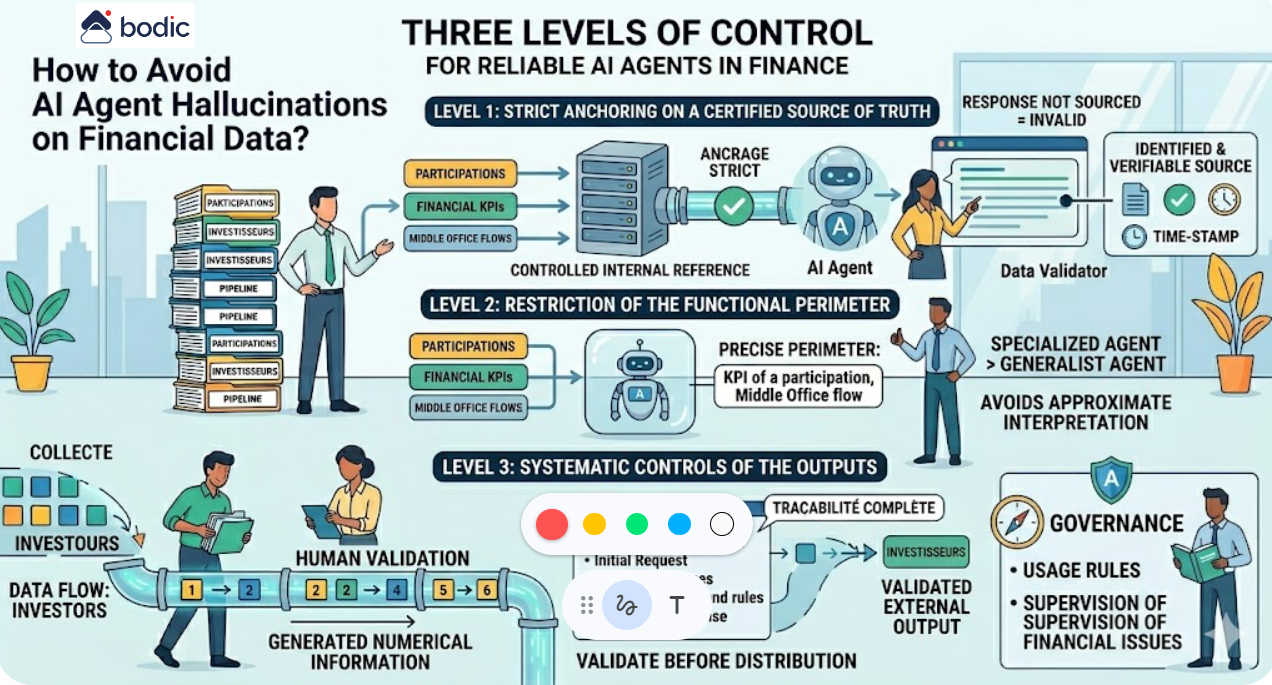
Hallucinations are the main risk when using AI agents in a financial context. They are not the result of random errors, but of the structural behavior of models in the absence of reliable or sufficiently constrained information.
Three levels of control can greatly reduce this risk.
The first is strict anchoring on a certified source of truth. The agent must not rely on general knowledge or implicit data, but only on a controlled internal repository. Each answer must be associated with an identifiable, accessible and verifiable source. An unsourced answer must be considered invalid by default.
The second level is the restriction of the functional and informational perimeter. An agent must intervene in a precise domain, with a limited and controlled set of data. The wider the scope, the greater the risk of approximate interpretation. In practice, an agent who specializes in a subset of financial data, such as a shareholding's KPIs or Middle Office flows, is significantly more reliable than a generalist agent.
The third level is the implementation of systematic controls on outputs. All numerical information intended for external use, in particular for investors, must be validated by a human being. This validation must be based on complete traceability: initial request, sources used, transformations applied and response generated.
Beyond these principles, technical architecture plays a decisive role. A structured approach consists in isolating the AI layer from raw data, using a centralized repository, then exposing only validated data to agents. This allows precise control over what the agent can see and use.
Finally, it's important to treat hallucinations as a governance issue, not just a technical problem. This means defining rules of use, levels of responsibility and supervisory mechanisms adapted to the financial stakes involved.
A reliable agent is not one that "responds well", but one whose every response can be explained, traced and verified.

Page 1 of 2 — 5 questions in total