How Can AI Improve the Quality of Middle Office Controls?
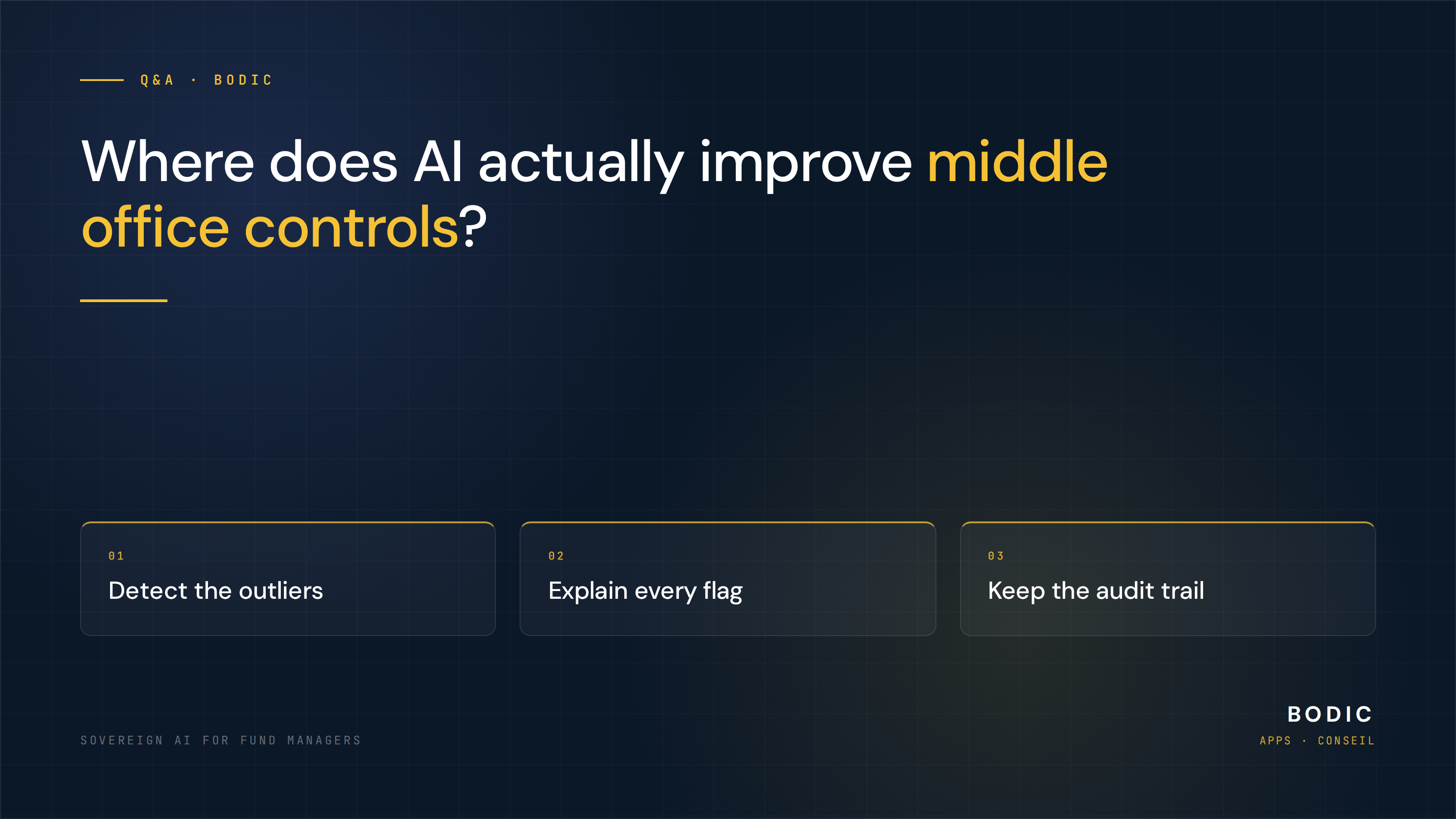
By shifting from sample-based verification to comprehensive verification, where humans now handle only the exceptions. AI doesn’t validate anything—it prioritizes, and that’s precisely what the teams are missing.
Three concrete benefits. First, detection: anomalous variations from one quarter to the next, inconsistencies between sources, and incomplete fields—across all rows, not just a sample. Next, explanation: each alert must be justified, including the rule that triggered it and the values in question; otherwise, the team will stop reading the alerts. Finally, traceability: who resolved the exception, on what basis, and with what supporting documentation, so that both the regulator and the valuator can follow the trail.
The Bodic Apps Middle Office module applies this logic to data shared with the rest of the platform, eliminating the need for cross-tool consistency checks. The definition of the control plan itself—including thresholds, priorities, and responsibilities—is part of the framework established in collaboration with Bodic Conseil.
Is it possible to effectively automate equity investment reporting?
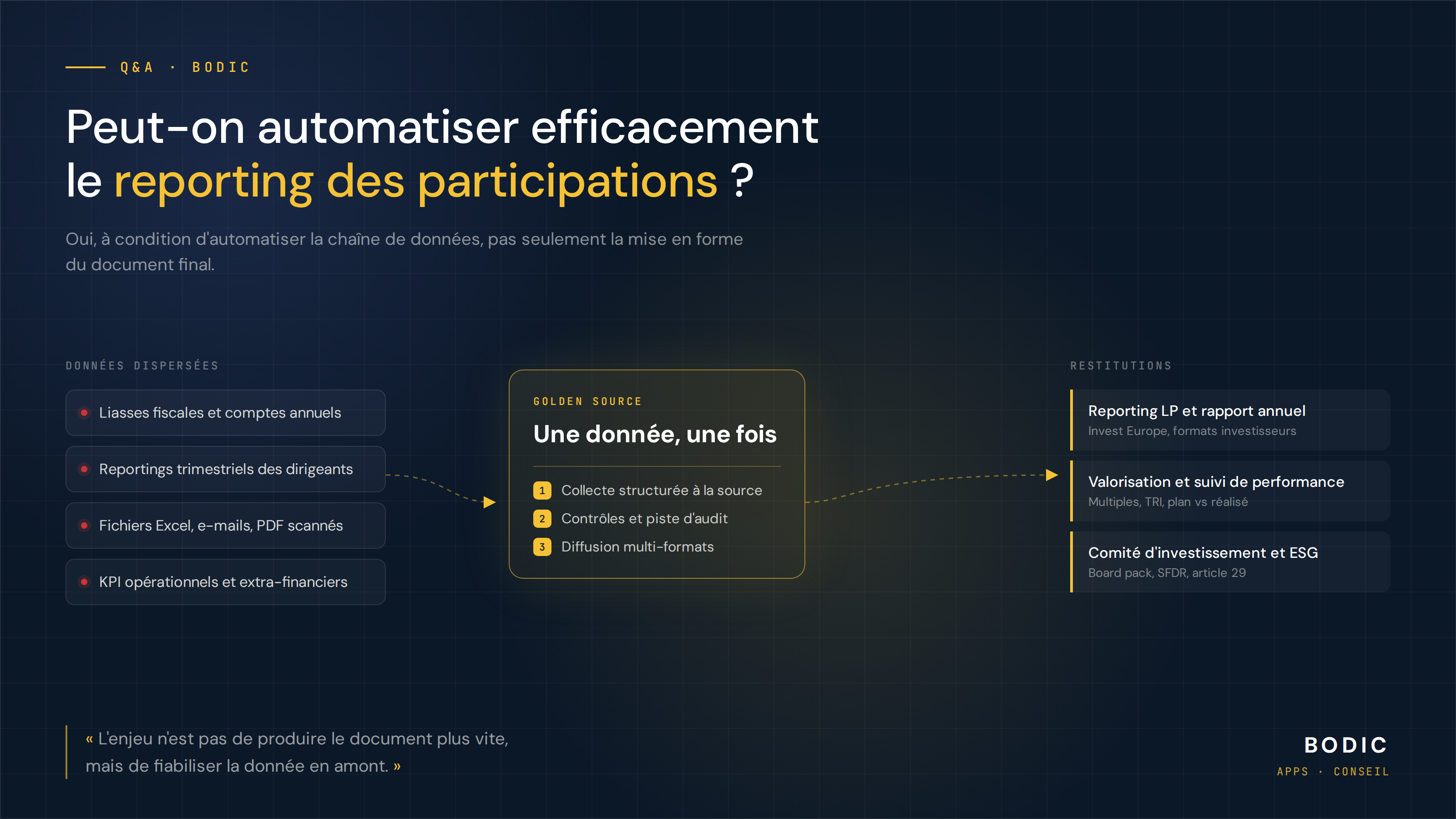
Yes, provided that the data pipeline is automated—not just the formatting of the final document. Most projects fail because they focus on the “last mile”—the LP report or board pack—when the real cost lies upstream: collecting, re-entering, and validating information produced by third parties in different formats and on different schedules.
Three levels of automation, in order of increasing value. First, data collection: a structured data entry portal open to executives at portfolio companies replaces the back-and-forth email cycle and makes the closing date predictable. This is the most significant—and most underestimated—source of savings. Next comes verification: consistency with the previous quarter, variances from the budget, and completeness, with an audit trail that answers the question, “Where does this figure come from?” Finally, reporting—which becomes a simple matter once the data is consolidated, dated, and validated.
There remains one line that must not be crossed. The selection of comparables, the treatment of an exceptional event, and the commentary provided to limited partners are matters of the manager’s judgment. The goal is not to remove the human element, but to reallocate it: less time spent fabricating the numbers, more time spent explaining them.
This is the approach adopted by Bodic Apps, where Portfolio Portal, Middle Office, and Golden Source share the same data rather than duplicating it. The preliminary framework, the set of performance metrics, and change management for portfolio companies are the responsibility of Bodic Conseil.
What is an AI agent in the context of a fund, and how is it different from a classic SaaS tool?
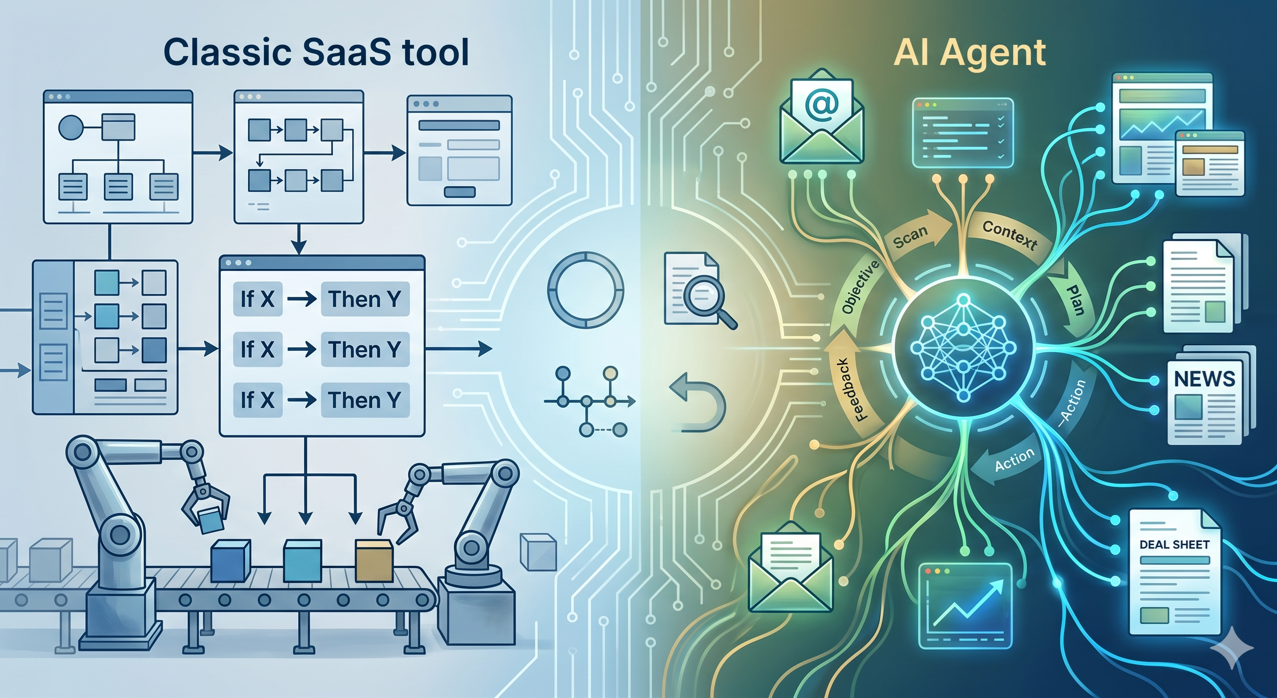
A classic SaaS executes pre-programmed actions: if X, then Y. An AI agent, on the other hand, receives an objective, understands the context, plans its steps and executes a sequence of actions, adapting to the data it encounters. This autonomy is both its interest and its risk.
In a fund, the relevant use cases for an agent are well-defined: processing supplier emails, enriching a deal sheet, automatically preparing a committee pack from a data room, monitoring signals on target companies. Ill-framed cases (making an investment decision, sending a communication to an LP without proofreading) are not cases for agents, they are cases for assisted humans.
A good agent has four characteristics: a clear perimeter, human supervision at every sensitive stage, complete traceability, and reversibility in the event of unexpected behavior. Bodic develops its agents according to these principles as part of its customized developments.
Can investment reporting be automated efficiently?
Yes, automating investment reporting is not only possible, it's also one of the most immediate ways of improving a fund's operations.
In the majority of organizations, the process is still based on manual data collection, with heterogeneous files transmitted by the investments, and consolidations carried out in Excel. This model introduces a number of weaknesses: dependence on non-standardized formats, risk of errors during reprocessing, lack of traceability and long production lead times.
Effective automation depends on structuring the data chain upstream.
The first step is to standardize inputs. This involves defining a common data dictionary with all participants, including clearly defined indicators, expected formats, explicit calculation rules and a reporting schedule. Without this standardization, all automation remains partial.
The second step is to organize data collection. This can involve dedicated portals, structured templates or connectors. The aim is to reduce format variations and limit manual intervention.
Third step: industrialize controls. Automatic rules are used to detect inconsistencies, variations, breaks in series or anomalies between related indicators. These controls must be systematic and traceable.
Fourth step: centralize in a single source of truth. Consolidated data must be fed directly into reporting, BI and investor communication tools, to avoid any duplication or local reprocessing.
In this context, automation helps to secure production, reduce lead times and significantly increase the reliability of deliverables.
The role of teams is changing. They move from a production logic to a control and analysis logic. The challenge is no longer to consolidate, but to interpret data, identify weak signals and prepare decisions.
Finally, governance remains the critical point. Automation without clear rules on data quality, responsibilities and validation processes can degrade overall reliability. Automation must be part of a rigorous framework, focused on control, traceability and consistency.